

Aerofine Classifier (AC)
Machinery & Equipment
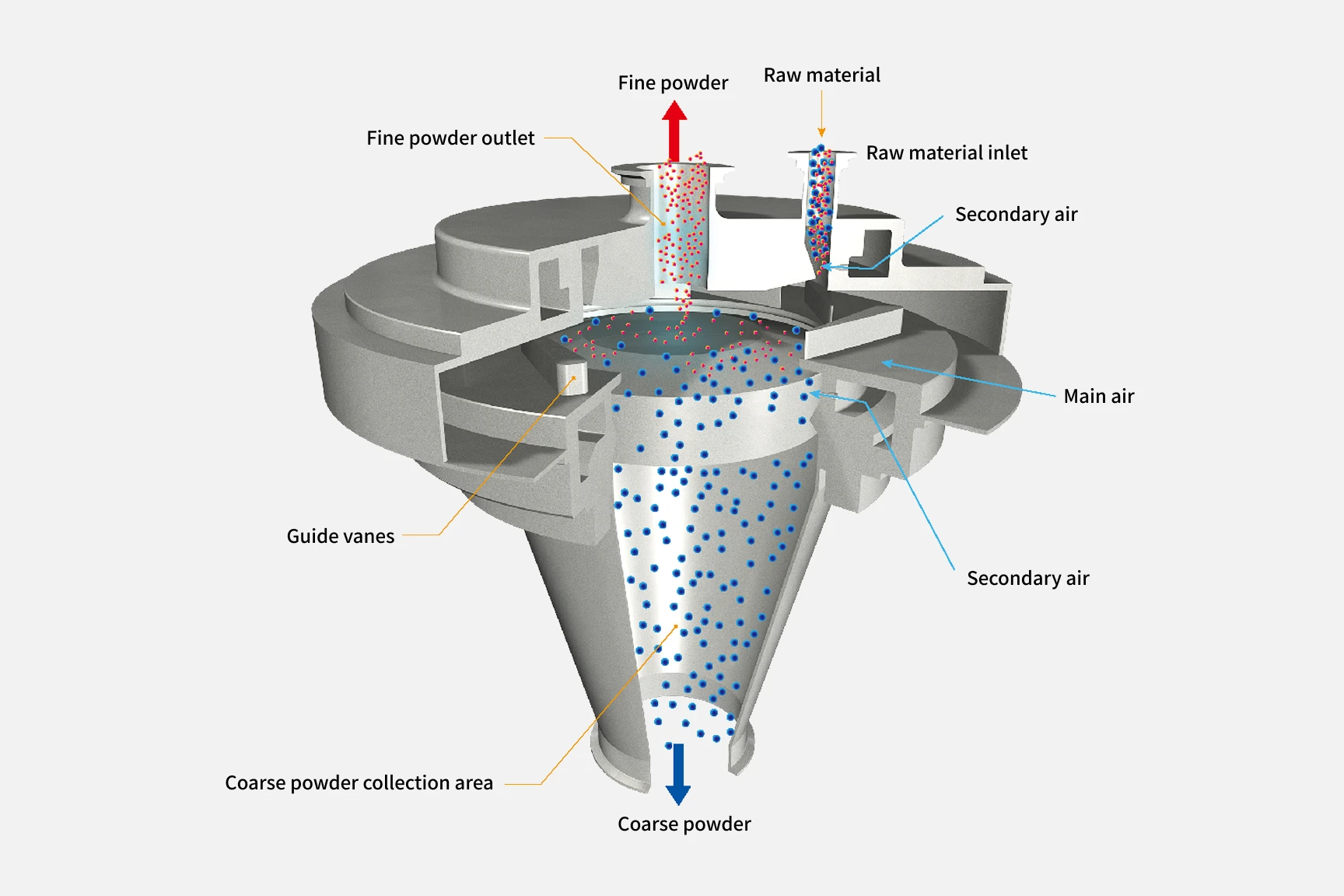
The Aerofine Classifier (AC) realizes high-accuracy classification at levels of single microns or smaller. Unlike classifiers that have rotating parts, a swirling
flow (free vortex) is generated by the fixed vanes to apply centrifugal force to particles. At the same time, air drag that acts in the opposite direction to the
centrifugal force is applied to particles. The classification point is set according to the balance between these two forces (centrifugal force and air drag), and
the particles are classified into coarse particles and fine particles. Compared to a forced vortex that is generated by the rotation of the classification vanes, a
free vortex tends to create a vortex at a higher speed and can apply greater centrifugal force to particles.
Classification at levels that could not be achieved has now been made possible by controlling a free vortex, which is difficult to control, with our proprietary
technology.
Structure
Micronization and high-accuracy classification achieved by an unique twin-air system
A swirling flow inside this equipment is generated by air that is sucked from the atmosphere by a blowder and passes through multiple inclined vanes installed on the outer cirmumference. In addition, a high-speed vortex is formed by injecting compressed air as the secondary air, leading to the achievement of further micronization and higher-accuracy classification of powder.
Simple structure with fixed vanes only and no rotor
This equipment has no moving parts inside. It is excellent in ease of disassembly and cleaning and allows easy handling of adhesive or abrasive powders.
Features
- Nanoparticle classification and submicron classification
- High accuracy and efficiency
- High dispersing performance
- Easy disassembly and cleaning
- Abrasion resistance achieved with ceramics (without metal contamination)
- Rotorless (contamination-free, easy cleaning)
- Processing under inert environment
- Further micronization of powder
Examples of classification
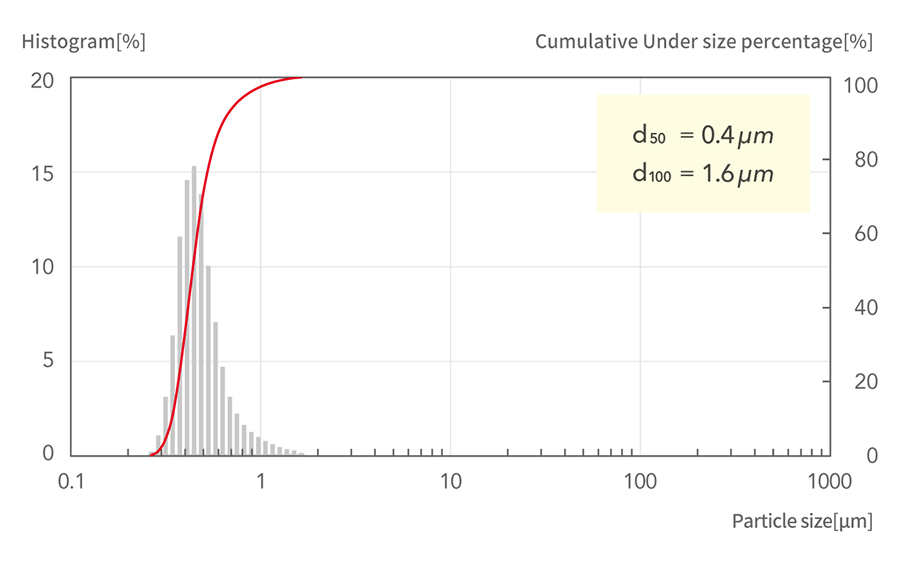
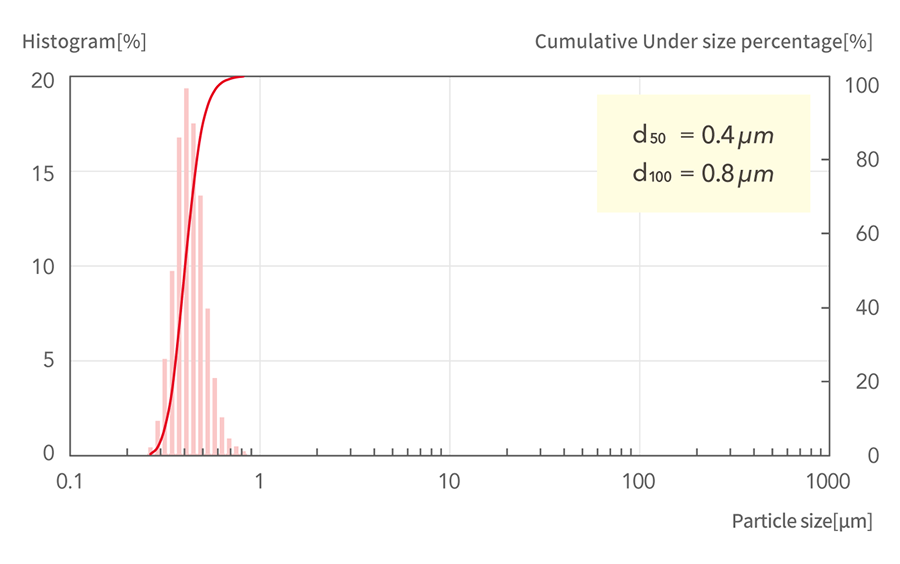
The presence of coarse particles that are larger than 1 μm in diameter and collected as fine particles is problematic for barium titanate that forms the dielectric
layer of multilayer ceramic capacitors.
Other conventional classifiers have not achieved the submicron classification and improvements of cohesion and adhesion. However, the Aerofine Classifier (AC)
solves these problems by forming a powerful vortex, realizing classification that the maximum diameter of fine particles is smaller than 1 μm.
Raw material
Product
Attempting the world’s smallest cut point
We are currently working on the application of the classification to nanosized superfine powder.
While maintaining the high-accuracy classification and simple structure with no rotor, which are the features of the conventional Aerofine Classifier (AC), we have
achieved classification at a nm level, which was impossible with a dry type, by generating a swirling flow at an even higher speed than the conventional type. We
will continue to take on the challenge of achieving the world’s smallest cut point.
Silicon powder
Raw material
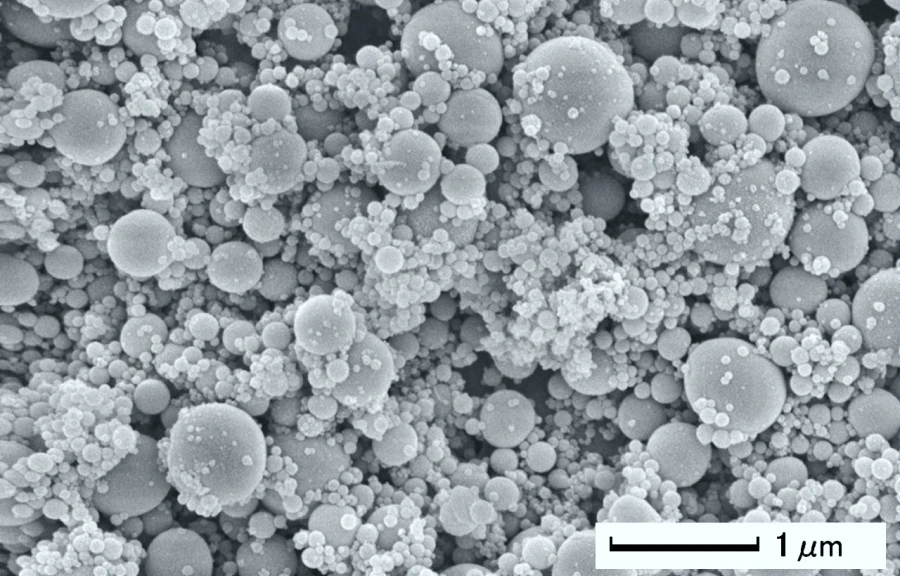
DBET:92nm
Fine powder
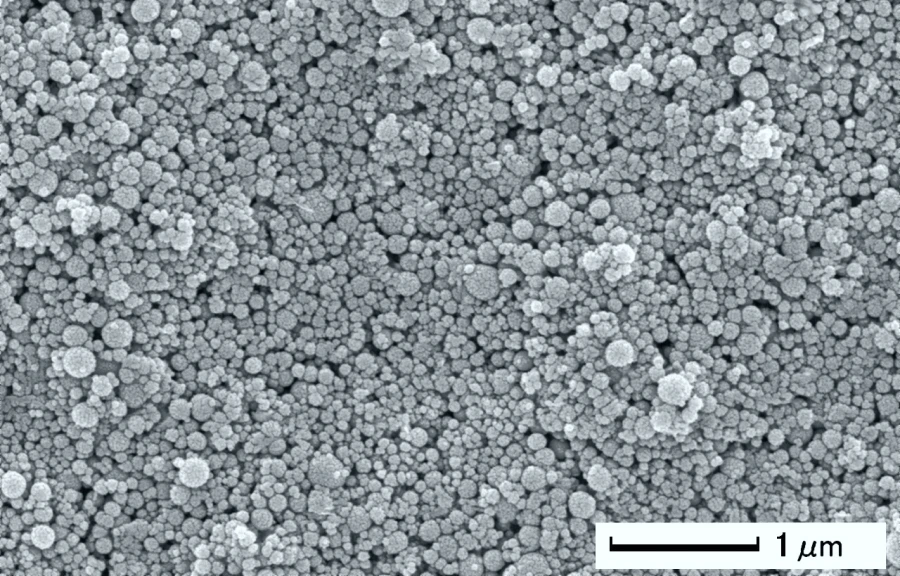
DBET:75nm
Nickel powder
Raw material
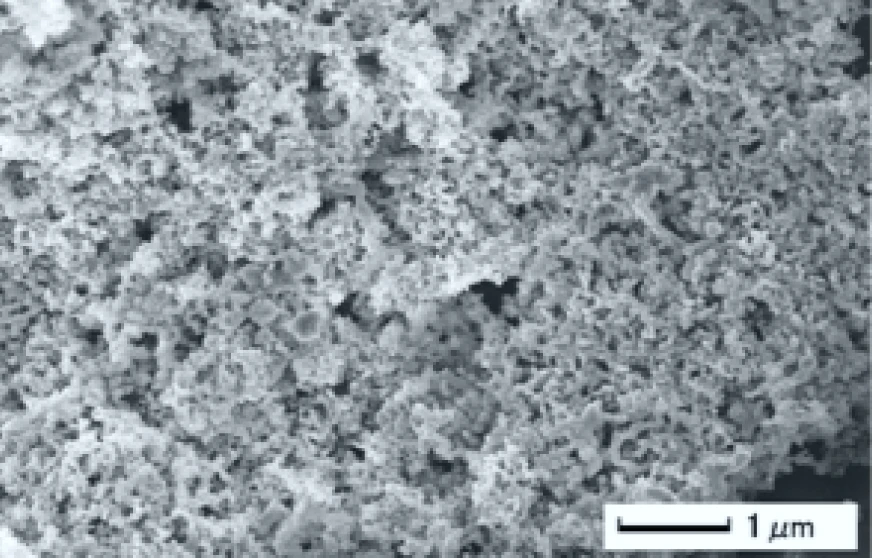
DBET:90nm
Fine powder
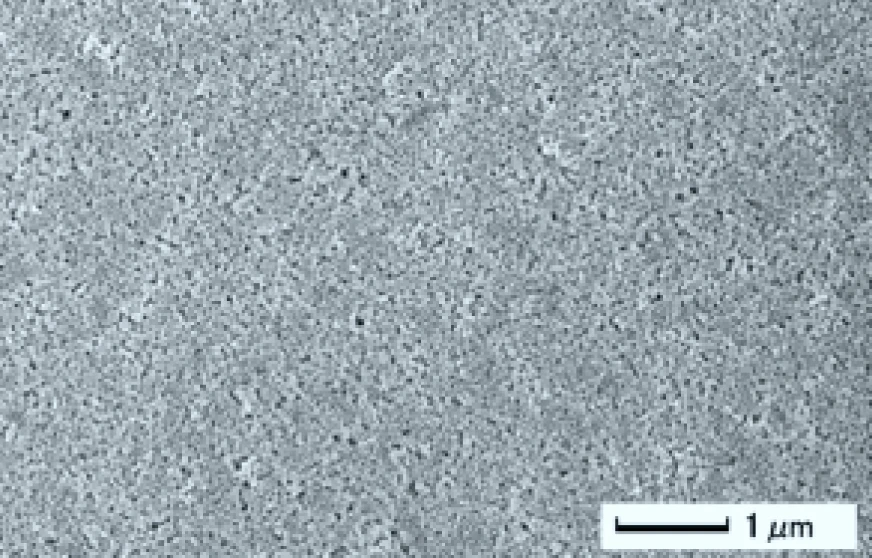
DBET:40nm